The eyes, ears and nostrils of crocodilians are positioned for use while the rest of the body is submerged. They have a well-developed bony palate, formed from several skull bones, similar to mammals. Crocodiles and alligators have an enlarged tooth near the front of the lower jaw, analogous to the canine in a mammal. In crocodiles this tooth tends to protrude, whereas in alligators it is normally more or less hidden in the living animal, fitting into a socket in the upper jaw.
|
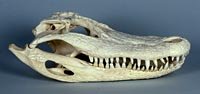
1. American Alligator skull, lateral view
Click for larger image
|
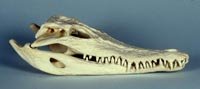
2. Saltwater Crocodile skull, lateral view
Click for larger image
|
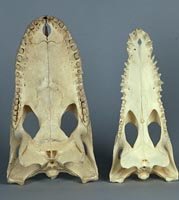
3. Alligator & Crocodile skulls, ventral view
Click for larger image
|
Internet Resources
Crocodile Specialist Group: An IUCN website, focused on conservation, with loads of info on crocs & alligators including a database of reported attacks by crocodilians (now over 2000).
Digimorph - Digital tomography (Alligator)
Youtube video on crocodylian skull anatomy
Reese, A.M. 1915. The Alligator and its Allies Electronic reprint by Arment Biological Press. Online, with an extensive section on the anatomy of the skull. |
|
Taxonomy:
Order - Crocodylia
Families - Alligatoridae & Crocodylidae
Scientific Name:
Crocodylus - "pebble-worm", from the Greek kroke (pebble) and drilos (worm), presumably referring to its knobbly skin. Reptiles were often grouped with worms in mediaeval texts.
porosus - "calloused" (Greek)
Alligator - From the Spanish 'el lagarto' (lizard)
Dental Formula
lots
Measurements: (explained)
Image 1 - American Alligator
Condylobasal length - 209mm
Overall width - 96mm
Image 2 - Saltwater Crocodile
Condylobasal length - 222mm
Overall width - 128mm
Collection Data
Image 1 - American Alligator
Stage - Adult
Area collected - USA
Source - Farmed specimen
Image 2 - Saltwater Crocodile
Stage - Adult
Area collected - Australia
Source - Farmed specimen
|
