|
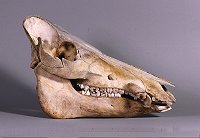
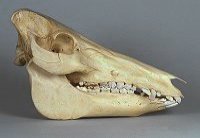
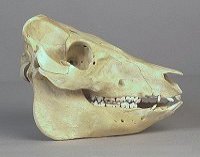
All domestic pigs are descended from the wild boar, Sus scrofa. Under domestication, the skull tends to become foreshortened, and the profile more concave.
Pig skulls have a distinctive high, sloping crest to the rear, formed by the supraoccipital and parietal bones and an additional, separate prenasal bone at the tip of the snout. These would seem to be adaptations for rooting, the high posterior crest providing additional leverage - a similar adaptation can be seen in the american badger. The teeth, too, are distinctive, the canines forming large tusks in both sexes, the upper growing outward or upward, and the cheek teeth having a unique pattern of small points and cusps.
. . cont. below
Also featured on this website, Peccary.
|
|
1. "British" Wild Boar
|
2. Wild Boar/Domestic Hybrid
|
|
3. Domestic Gilt (immature)
|
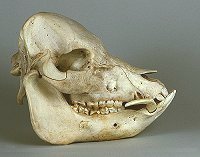
4. Vietnamese Pot-bellied Pig
|
|
Wild S. scrofa and its domestic descendents are widespread throughout the world. Some of the free-living animals may be truly wild stock, while others are domestic varieties gone feral, or may have interbred with domestic pigs to varying degrees. There is evidence of domestic pigs in the pre-pottery layers of Jericho (7000BC).
It is therefore often difficult to assign pigs to a particular subspecies or variety although attempts have been made to find a magic measurement which would sort out at least some of the main groups. Attention has been focussed on the lacrimal bone, which tends to persist in archaeological deposits and has a variable shape, perhaps reflecting elements of skull shape such as the foreshortening of domestic varieties. It may in fact be too variable, and it has been suggested that the shape can be affected by the amount of rooting a pig does in its early months, due to the effect of a muscle running from the lacrimal to the snout tip.
Pig tusks self-sharpen against each other.
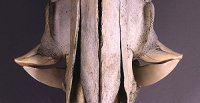
It is nevertheless pretty obvious that the domestic gilt and vietnamese pot-belly illustrated here are domestic varieties, due to their foreshorted skulls.
Internet Resources
Standard references :
Smithsonian / Wilson & Reeder's Taxonomic List
University of Michigan Animal Diversity Web
|
|
Taxonomy:
Order - Artiodactyla (cloven-hoofed)
Family - Suidae (pigs)
Subfamily - Suinae
Scientific Name:
Sus "pig" (Latin)
scrofa "breeding sow" (Latin)
English Name:
The origin of the word "pig" is uncertain, but an Old English word for acorns is "picbred" - presumably "pig-bread".
Dental Formula
U 3.1.4.3 - L 3.1.4.3
Measurements: (defined)
See variety pages
Collection Data
See variety pages

|
